
 maps4kids team
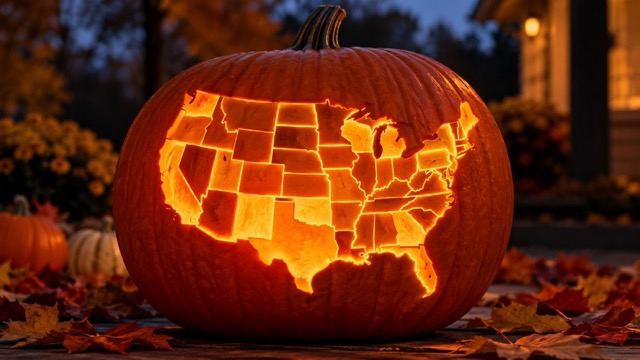
From ancient Ireland to pumpkin-filled porches in America and colorful celebrations in Mexico, discover how Halloween traveled around the world!
Ghosts, witches, costumes, candy, and glowing jack-o’-lanterns! Halloween is full of spooky fun. But have you ever wondered where Halloween came from, why we carve pumpkins, or why people in different countries celebrate this time of year in different ways?
The answers have a lot to do with geography!
Geography isn’t just about mountains, rivers, and country borders. It is also about people, places, climate, food, history, and how ideas travel from one part of the world to another.
So grab your imaginary passport. We’re going on a Halloween adventure!
Where Did Halloween Begin?
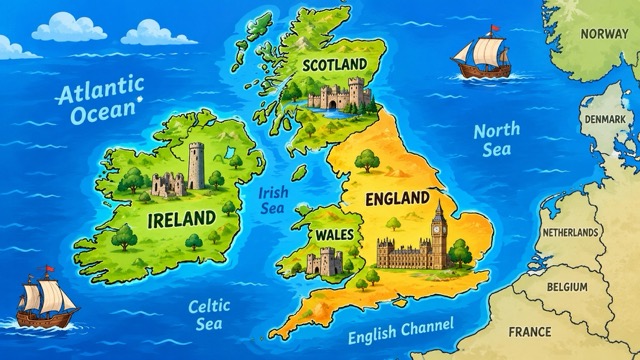
Our journey begins more than 2,000 years ago in a part of Europe that includes modern-day Ireland, the United Kingdom, and nearby regions.
People in these areas celebrated an ancient Celtic festival called Samhain (pronounced roughly “sow-in”). It marked the end of the harvest season and the beginning of the darker, colder part of the year.
Imagine living hundreds of years ago, without electric lights, supermarkets, or weather forecasts. When autumn ended, farmers needed to prepare for winter. They had to gather crops, store food, and bring animals into shelter. The days were getting shorter, and winter could be a difficult time.
Samhain was an important seasonal celebration. People lit bonfires, and some wore disguises because they believed spirits could visit the world of the living.
As Christian traditions developed in Europe, Samhain became connected with religious observances honoring saints and the dead. The evening before All Saints’ Day became known as All Hallows’ Eve. Over time, that name shortened to Halloween.
Today, Halloween is celebrated in many countries, but its history helps explain why the holiday falls on October 31.
Geography challenge: Find Ireland on a map. Can you also locate Scotland, England, and Wales? These places are part of the story of Halloween’s early history.
Why Do We Carve Pumpkins?
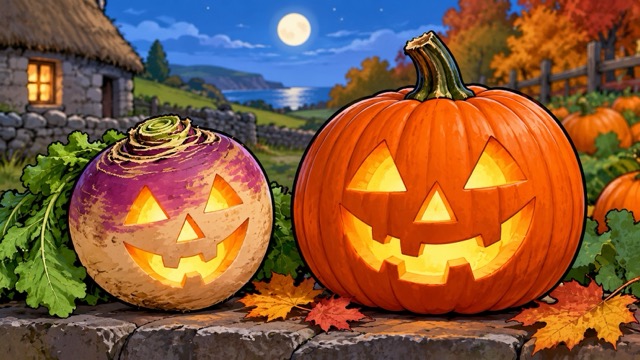
Here’s a Halloween surprise: the earliest jack-o’-lanterns weren’t made from pumpkins!
In Ireland, people traditionally carved scary faces into turnips and other root vegetables. These glowing lanterns were connected with local folklore and beliefs about spirits.
Then geography changed the story.
During the 1800s, many Irish people emigrated to North America. They brought their customs and stories with them. In the United States, they found a large orange fruit that was much easier to carve than a small, hard turnip: the pumpkin!
Pumpkins were already familiar crops in North America, where Indigenous peoples had grown them for thousands of years. Pumpkins became a natural choice for Halloween lanterns.
Today, carved pumpkins are one of the best-known symbols of Halloween.
This is a great example of how migration changes traditions. People move to new places, bring their customs with them, and sometimes adapt those customs to the foods, materials, and opportunities they find there.
Geography challenge: Find Ireland and the United States on a world map. Can you trace a route across the Atlantic Ocean that Irish emigrants might have taken? Try an outline map from Maps4Kids.com !
How Did Halloween Spread Across the World?
Halloween didn’t become the holiday we know today all at once.
Over many centuries, traditions changed as people moved, religions influenced local customs, and communities borrowed ideas from one another.
Irish and Scottish emigrants helped bring Halloween traditions to North America. In the United States and Canada, customs such as dressing up, carving pumpkins, and visiting neighbors for treats became increasingly popular.
In the United States, trick-or-treating grew into a widespread children’s activity during the twentieth century. Movies, television, advertising, and the internet later helped Halloween costumes and decorations become familiar to people far beyond North America.
Today, Halloween parties, costumes, and trick-or-treating can be found in many places around the world. But not every country celebrates in the same way, and some have their own older traditions at this time of year.
That is what makes cultural geography so interesting: a tradition can travel, change, and become part of a place’s story.
Mexico: A Different Way to Remember Those Who Have Passed
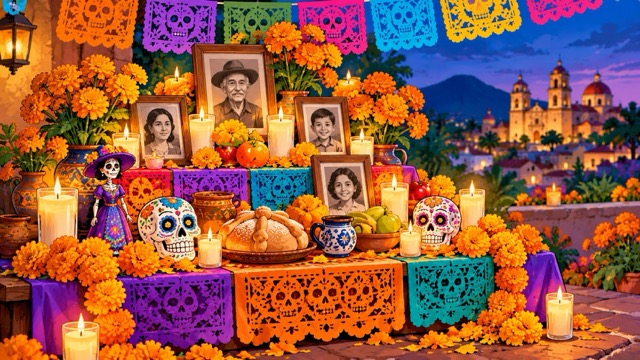
In Mexico, the beginning of November brings an important celebration called Día de los Muertos, or the Day of the Dead.
Although it happens around the same time as Halloween, it is a distinct holiday with its own history and meaning.
Día de los Muertos has roots in Indigenous traditions that honor ancestors. Over time, these traditions blended with Catholic observances brought by the Spanish, including All Saints’ Day and All Souls’ Day.
Many families create special altars called ofrendas. They may decorate them with photographs of loved ones who have died, candles, colorful paper decorations, marigold flowers, and favorite foods.
Families may visit cemeteries, share stories, prepare traditional dishes, and celebrate the lives of relatives they remember.
One famous food is pan de muerto, a sweet bread made especially for the occasion.
The geography connection is fascinating. Mexico’s history includes Indigenous civilizations, Spanish colonization, and centuries of cultural exchange. These different influences helped shape traditions that are distinctly Mexican.
Día de los Muertos is not simply Mexican Halloween. The two celebrations occur around the same time, but they have different histories, customs, and meanings.
Geography challenge: Find Mexico on a map. Can you locate it in relation to the United States, the Pacific Ocean, and the Gulf of Mexico? Try an outline map from Maps4Kids.com !
Ireland: Halloween’s Historic Home
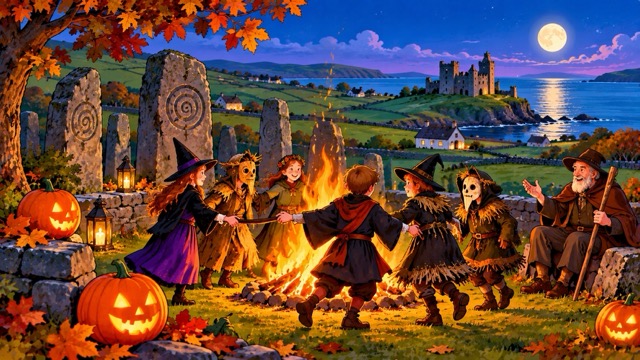
Let’s return to Ireland, where many of Halloween’s best-known traditions have deep historical roots.
In addition to costumes and carved lanterns, traditional Irish Halloween celebrations included games, storytelling, bonfires, and special foods.
One traditional food is barmbrack, a fruit bread associated with Halloween. In some versions, small objects were baked inside the bread and were thought to predict a person’s future. Today, food safety matters, so don’t try baking objects into a cake at home!
People also played games involving apples. These traditions made use of seasonal harvest foods and helped bring communities together as autumn turned toward winter.
Why apples? Because local foods often influence local customs. In places where apples were grown and harvested in autumn, they were a natural part of seasonal celebrations.
This is another way geography influences culture: what grows in a place can become part of its traditions.
Geography challenge: Ireland has a mild, often rainy climate influenced by the Atlantic Ocean. Find the Atlantic on a map. How might the ocean affect Ireland’s weather?
Halloween in the Southern Hemisphere
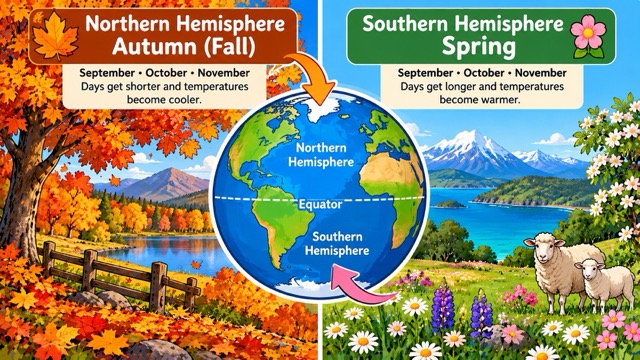
Here’s a geography puzzle: Halloween takes place on October 31. But does that mean it is autumn everywhere?
Not at all!
In countries such as the United States, Ireland, and England, October is part of autumn. The days are getting shorter, leaves may be changing color, and temperatures are often dropping.
But in countries such as Australia, New Zealand, and South Africa, October is in spring!
That’s because the Northern and Southern Hemispheres experience opposite seasons. When one hemisphere tilts away from the Sun, it receives less direct sunlight and moves into its colder months. The other hemisphere is tilted more toward the Sun and moves into its warmer months.
Halloween decorations might look similar in Sydney and New York, but the weather outside can be very different.
You might wear a warm jacket with your costume in one place and enjoy a spring evening in another.
Geography challenge: Find Australia and New Zealand on a world map. If Halloween is in spring there, what season will it be there at Christmas?
Halloween Around the World: One Date, Many Traditions
Halloween is now internationally recognizable, but different places have their own customs, and not everyone celebrates it.
Here are a few places to compare:
- United States and Canada: Trick-or-treating, carved pumpkins, costume parties, and decorated homes are popular in many communities.
- Ireland: Halloween has deep roots in the older festival of Samhain, alongside modern celebrations, games, and seasonal foods.
- Mexico: Halloween may be celebrated in some communities, while Día de los Muertos on November 1 and 2 is an important occasion for remembering loved ones.
- Australia and New Zealand: Halloween events and trick-or-treating take place in some communities, even though October is a spring month.
These examples show that holidays are not frozen in time. They change as people travel, cultures interact, and new generations create their own traditions.
And remember: a country is never just one tradition. Celebrations can vary from one family, town, or region to another.
The Geography of Halloween: Five Things We’ve Learned
Let’s review the geography behind the spooky season!
1. Location matters. Halloween’s history begins with traditions in parts of Europe, including Ireland and Scotland.
2. Migration spreads ideas. Irish emigrants helped carry Halloween customs across the Atlantic to North America.
3. Local resources shape traditions. Turnips were used for lanterns in Ireland, while pumpkins became popular in North America.
4. History shapes celebrations. Halloween and Día de los Muertos have different histories, even though they occur close together on the calendar.
5. Climate affects seasonal life. October is autumn in the Northern Hemisphere but spring in the Southern Hemisphere.
Geography helps us understand not just where a holiday is celebrated, but also why it looks different from place to place.
Your Halloween Geography Challenge!
Ready to become a Halloween geography explorer? Try these activities.
Challenge 1: Map the journey
On a world map, locate Ireland, Scotland, England, the United States, Mexico, Australia, and New Zealand.
Draw a line showing how Halloween traditions traveled from Ireland across the Atlantic to North America. Then mark Mexico, where Día de los Muertos has its own distinct history.
Challenge 2: Seasonal detective
Write down the season in each place on October 31:
- Ireland
- United States
- Mexico
- Australia
- New Zealand
Can you explain why the seasons are different?
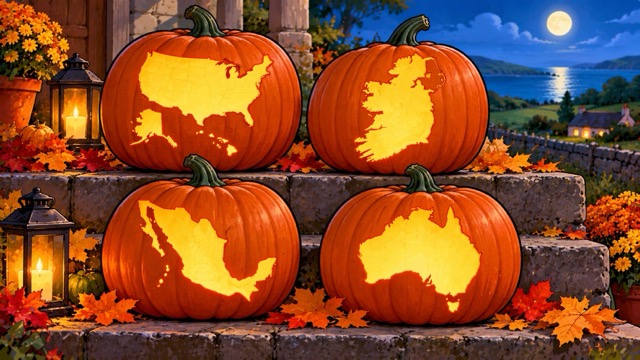
Challenge 3: Invent a geography-inspired jack-o’-lantern
Design a pumpkin that represents a country or region. You could carve a mountain range, draw a country’s outline, add an animal found there, or use symbols inspired by a local landscape.
Remember to ask an adult for help with carving!
Challenge 4: Become a cultural explorer
Ask a friend or family member how Halloween or another autumn celebration is observed where they live. What foods, decorations, stories, or activities are part of the celebration? How is it similar to or different from your own traditions?
Happy Halloween, Geography Explorers!
Halloween is much more than candy and costumes. It is a journey through history, across oceans, and into the traditions of different cultures.
From ancient seasonal festivals in Europe to pumpkin lanterns in North America and family remembrance in Mexico, the story of Halloween shows us how people, places, and ideas are connected.
So the next time you see a glowing jack-o’-lantern, remember: even a simple Halloween pumpkin has a geography story!
Keep exploring the world with Maps4Kids!


Add comment